Home Game Guide
How to Host a Friendly Home Poker Game Without Ruining Friendships
A simple tournament-style format that caps spending, keeps the game moving, and makes sure everyone leaves the table still wanting to hang out next week.
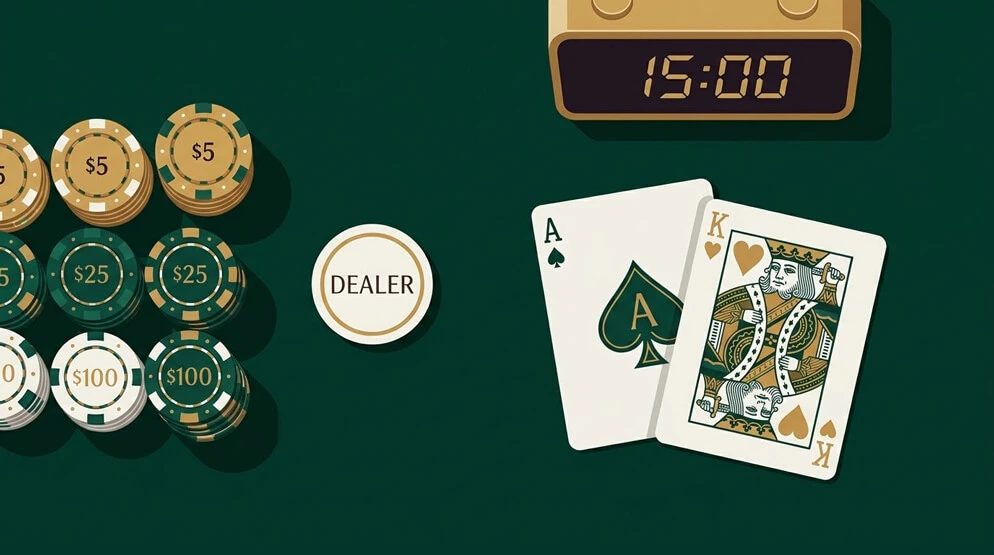
Why open-ended rebuys and IOUs hurt a friendly game
The fastest way to sour a home game is not a bad beat. It is an open-ended tab. Someone rebuys “just one more time,” someone else covers it with an IOU, and by midnight the poker has quietly turned into a small, awkward loans office. Nobody planned to lose more than they expected, but nobody set a limit either.
The cards were never the problem — the structure was. When the game has no fixed end and no fixed cost, the stakes keep drifting and the person who is stuck keeps chasing. A short, capped tournament removes that pressure. Everyone knows what they can lose before the first hand is dealt, and the game finishes while people still like each other.
None of this needs a casino setup. A kitchen table, a cheap chip set, and a phone timer are enough. Decide the money rules first, then let the cards do the talking.
The three rules that keep it friendly
Every home game that goes well follows the same three rules. They are simple enough to explain in a minute and firm enough to settle an argument at 1 a.m.
Fixed buy-in, deep starting stack
Agree on the buy-in before anyone sits down. Both a $5 night and a $10 night start every player with 2,500 in chip value — 125 big blinds at 10/20. The buy-in is the only money that changes hands.
When a stack busts, the player is out: no rebuys, no top-ups, and no IOUs on the back of a beer mat. A hard cap means nobody can lose more than they planned, and nobody has to chase a friend for cash on Monday.
A timer that raises the minimum bet each round
Put a timer on the table and raise the blinds every 15 to 20 minutes. Short levels keep the game moving and stop one deep stack from grinding everyone down all night.
A typical ladder runs 10/20, 20/40, 30/60, 50/100, 100/200, 200/400, which usually wraps a single-table game in two to three hours. Announce each level change out loud so nobody misses it.
Simple 1st- and 2nd-place prize split
With five or more players, pay two places: 70% to first and 30% to second, rounded to the nearest chip. With three or four players, either pay the winner outright or agree on a chop before the first hand.
Write the payout on the same note as the buy-in so there is nothing to negotiate at the end of the night. Anyone who wants to play differently can say so before they sit down.

- 1st place — 70% of the pool
- 2nd place — 30% of the pool
- Eight players at $10 make an $80 pool: $56 for first, $24 for second. Round to whatever chip you have and write it down.
Sample home tournament setup
Two configurations cover almost every friendly game. Pick one before people arrive, then text or print the blind ladder so everyone starts on the same page.
| Setting | Casual $5 Night | Standard $10 Night |
|---|---|---|
| Buy-in | $5 | $10 |
| Starting stack | 2,500 in chip value | 2,500 in chip value |
| Blind levels | 15 minutes | 20 minutes |
| Typical field | 5–8 players | 6–9 players |
| Expected length | About 2 hours | About 3 hours |
| Prize split | 70 / 30 | 70 / 30 |
A six-level blind ladder
- Level 110 / 20
- Level 220 / 40
- Level 330 / 60
- Level 450 / 100
- Level 5100 / 200
- Level 6200 / 400
Each level shows small blind / big blind. Add a ten-minute break after level three, and stop registering new players once the first hand is dealt.
When rising blinds create short-stack all-ins
This is where the format meets the poker. A stack that felt healthy at 10/20 looks short by 100/200, so someone eventually shoves their last chips into the middle. At that point the pot has to split into layers: a main pot that every remaining player can win, and one or more side pots that only the covering players can win.
If two short stacks shove in the same hand you can end up with three or four pots and a pile of chips returned to whoever bet more than anyone called. Getting that split wrong is the other classic way a friendly game stops being friendly — not because anyone cheated, but because nobody could agree who was owed what.
Enter the bets into the calculator and it builds the layers for you, marks who is eligible for each pot, and shows any uncalled chips before they are awarded.
Open Side Pots CalculatorGathering the gear? Start with First-Time Home Poker Guide: Gear, Setup & How to Deal for table size, starter chips, and dealing basics.